Webflow's new Assets agent needs your brand variables already set
By The WAALEE Team · · 4 min read
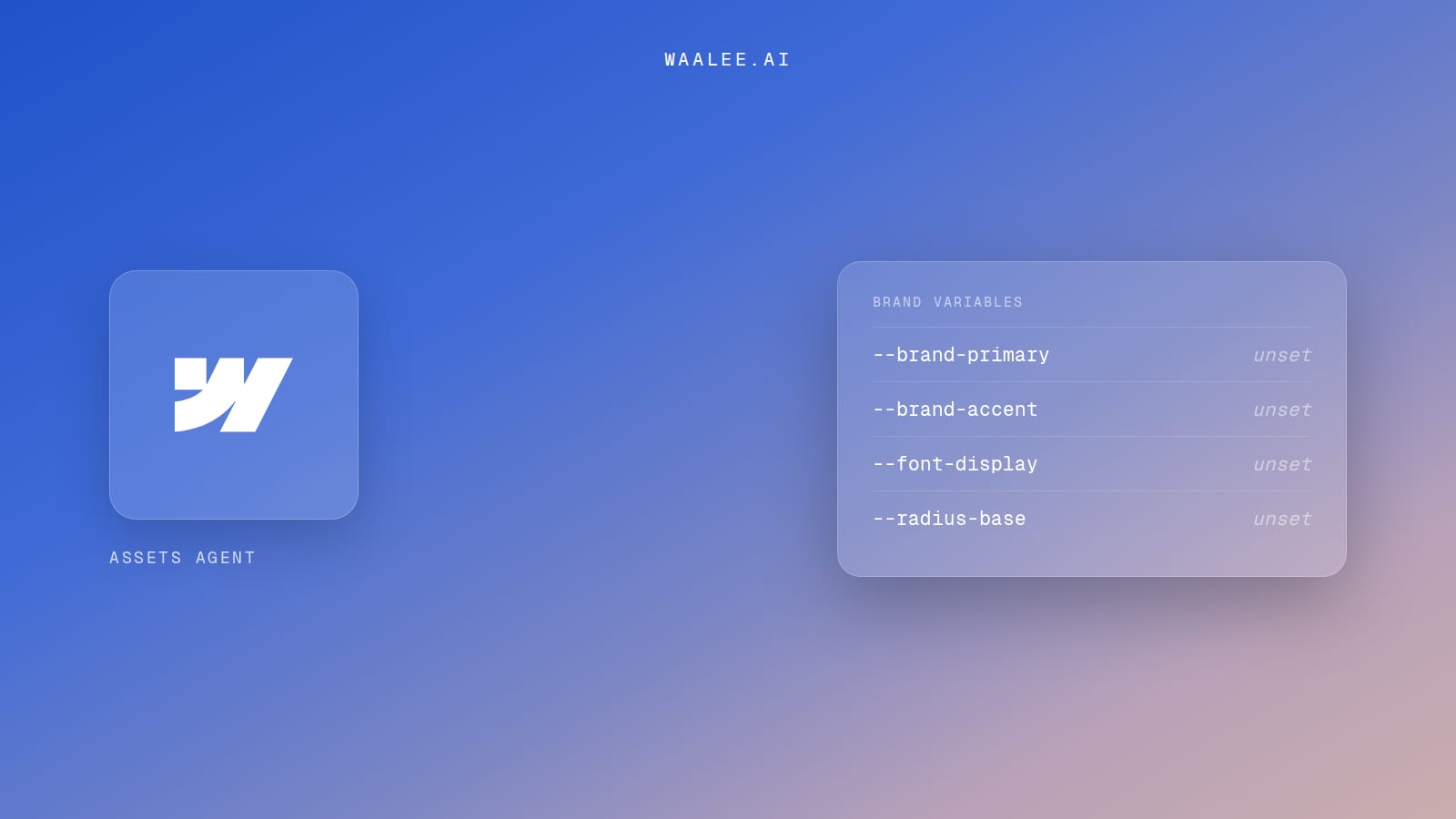
Webflow Conf 2026 wrapped up in Boston earlier this month with a stack of announcements, but the one worth reading past the headline is Assets, a new agentic way to produce and adapt branded creative, built on technology from Vidoso, the AI asset-generation startup Webflow acquired back in March. The pitch is that an agent can now cut a full video down for social, trim filler words, add captions, and resize a static asset across channels, all while staying on-brand automatically. Read the actual requirements and it's the same shape as every other AI branding feature this year: it works once your brand is already defined somewhere machine-readable. It doesn't define it for you.
What Assets actually needs before it runs
Webflow is specific about this, more specific than most vendors bother to be. Per its own announcement, to solve the problem of AI-generated content lacking context, the Assets agents need your design system, your brand variables, your existing asset library, and how those assets have performed. That's four separate inputs, and every one of them assumes a team already did the work of setting up Webflow's Shared Libraries, defining brand variables as actual variables (not just colors picked ad hoc on each page), and building up a library of assets Webflow considers approved. Skip any one of those and there's no context for the agent to read.
It finds and adapts. It doesn't originate.
The mechanism itself is genuinely useful: the agents find, understand, and adapt your approved assets to work across channels, so a hero image built for the homepage can get reflowed for a social crop, or a long-form video can get cut into captioned clips, without a designer touching either by hand. That's real leverage for a marketing team that already has a defined brand living inside Webflow. It's leverage on distribution, not creation. If your actual brand only exists on a live site nobody ever wired into Shared Libraries as variables, Assets has no approved library to search and no brand variables to check adaptations against.
Beta timing means this gap matters now, not eventually
Assets enters beta this October, which is close enough that teams evaluating it should know what they're walking into. This isn't a hypothetical six-months-out roadmap item where there's time to casually get around to setting up brand variables. If a team wants to actually test Assets when the beta opens and their site was built years ago, by an agency, with hex codes typed into a color picker one page at a time, the setup work (turning that live rendering into real Webflow variables and an approved library) is the thing standing between them and a useful first session.
- Assets reads your design system, brand variables, existing asset library, and past performance data, four inputs that have to already exist inside Webflow.
- The agent adapts and distributes approved creative across channels. It has no step for deciding what your brand's real colors and type are in the first place.
- It's built on Vidoso, an asset-generation engine, not a brand-extraction one, so it optimizes creative once brand context is supplied, it doesn't supply that context.
- Beta opens this October, which makes getting real brand variables into Webflow now, not later, the actual prerequisite for testing it well.
Get the variables in before the beta opens
The fastest way to have Webflow's design system and brand variables actually match your real brand, rather than a rough guess typed in from memory, is to pull the values off the page where your brand already renders: your live site, whatever it's built in. Read the real computed colors, the actual type scale, the true spacing rhythm off the rendered DOM, and you can wire those straight into Webflow's variables and Shared Libraries as exact values instead of an approximation. That turns the four inputs Assets is waiting for from a blocker into a checklist you clear in one sitting.
Three pieces of the same pipeline, and where the brand values actually have to start:
- Webflow Assets: Finds, adapts, and distributes approved creative across channels once your design system, brand variables, and asset library already exist. Beta opens October 2026.
- Webflow Shared Libraries: Where those brand variables, components, and assets actually have to live for Assets (or anything else in Webflow) to read them. Setup is manual, page by page, unless the values are already exact.
- WAALEE: Paste a live URL and get the real colors, type scale, and spacing back as exact values in seconds, ready to enter into Webflow's brand variables instead of guessing them from memory before the Assets beta opens.
None of this is a knock on what Webflow built. An agent that can adapt approved creative across a dozen channels without a designer manually resizing each one is a real, compounding time save, and being explicit about the four inputs it needs is more honest than most "just describe your brand" pitches in this space. The gap is the same one every agentic branding feature this year keeps leaving in the same place: it's good at working with a brand once one is defined. Defining it, precisely, is still the step that happens before any of this runs.